
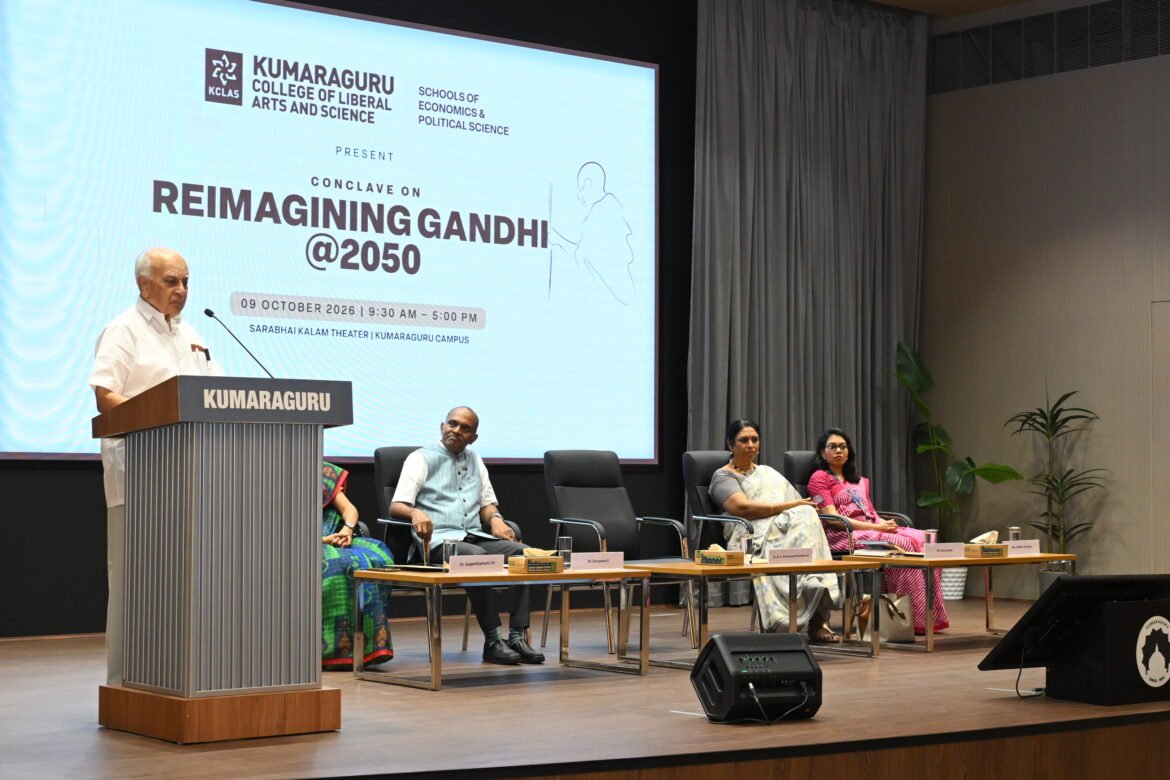
The Gandhian model remains relevant to addressing contemporary challenges and building an inclusive society, particularly in protecting democracy, upholding the Constitution, preserving India’s pluralistic character and making nation-building a people’s movement, said Dr. B. K. Krishnaraj Vanavarayar, Chairman, Kumaraguru Institutions.
Delivering the presidential address at the conclave Reimagining Gandhi @2050: Sustainable Future Through Gandhian Thought and Transformative Economic Practices, organised by the Schools of Economics and Political Science at Kumaraguru College of Liberal Arts and Science (KCLAS), he identified five priorities for contemporary India: protecting freedom and democracy, upholding the Constitution, preserving the country’s pluralistic character, making nation-building inclusive and participatory, and safeguarding the fundamental human values of love and compassion.
He said India’s freedom and democracy were secured through a long struggle and should not be taken for granted. Upholding the Constitution and respecting the country’s diversity were equally important for its future. Highlighting the relevance of Gandhian thought to economics, he described the Gandhian model as the creation of wealth through fair means, its equitable distribution, and economic development that does not damage nature. Such an approach, he said, places human well-being, sustainability, lasting peace and happiness at the centre of economic progress.
Contrasting this approach with the idea that only the fittest can survive, he drew attention to the Gandhian principle of making everyone capable of surviving and progressing. He urged economists and policymakers to reconsider development through the lens of equity and social responsibility, rather than measuring progress only through economic growth.
He also encouraged the participants, including scholars and researchers who had travelled from different places, to examine Gandhian thought in relation to present-day political, economic and social questions. He said discussions on economics and political science should move beyond theoretical understanding and explore how ideas could inform responses to real-world challenges.
The conclave brought together perspectives on Gandhian thought, economics, political science, peace and sustainability, with discussions focused on the relevance of ideas such as Swaraj, Sarvodaya, non-violence and ethical economics to the future of society.
Leave a Reply